Bright Red Roofed Cupola Important Part of Battle Creek History
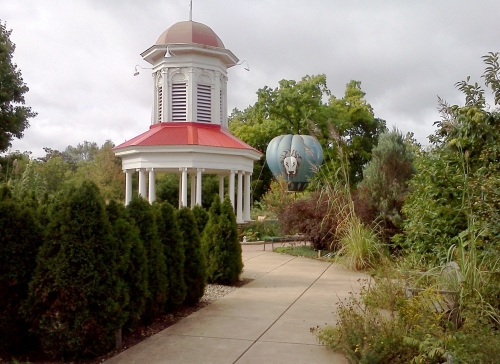
Driving west on Michigan Avenue from downtown Battle Creek area, one suddenly sees on the right a model hot air balloon and bright red roofed cupola of the Leila Arboretum’s Children’s Garden.
The cupola is at the heart -- the center -- of the Children’s Garden as it also was, for all of Battle Creek, near the turn of the 19th Century when the Battle Creek Sanitarium drew thousands of patients in search of better health, and, not long after, the birth of the related Battle Creek breakfast cereal boom.
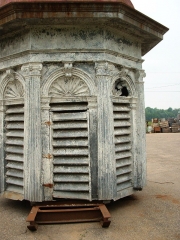 The large handsome louvered cupola originally topped a pillared wrap-around porch of the grand fieldstone building (the largest in the United States) which opened as the Phelps Sanitorium on Washington Avenue, across from Emmett Street on October 10, 1900.
In 1911, the “Fieldstone Building” was acquired by Dr. John Harvey Kellogg, as an annex to the Battle Creek Sanitarium. It was later used as a hospital by the Seventh-Day Adventist Church. After years of attempting to raise the significant funds that were necessary to save and restore the then condemned Fieldstone Building, it was concluded the enormous expense was too great of a burden for this small community to undertake. In December 1985, demolition began on what was North America’s largest fieldstone building.
Garth “Duff” Stoltz, a former employee of the Fieldstone Building and a Battle Creek historian, led a group of Battle Creek citizens in an effort to preserve some part of this unique building for history and future generations. Thus began the quest to save the cupola as a memento to what once stood tall in the Battle Creek community as a symbol of health and scientific discovery.
Because the demolition company owned all remains of the building, Stoltz and the Adventist Hospital purchased the cupola for $2,600.
In 1993, Dr. Tom Bruce of the W. K. Kellogg Foundation and Board President of Leila Arboretum Society (LAS) at the time, approached Stoltz and Ronald Brown, president of the Adventist Hospital to consider donating the Cupola to LAS. Through the perseverance of Dr. Bruce, Stoltz and Brown agreed to donate the Cupola to LAS in exchange for a donation of $2,600 from Dr. Bruce to the Adventist Church.
LAS wanted to restore and preserve the cupola and make it once again available to the community.
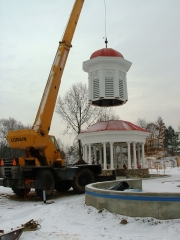 In 2000, the Leila Arboretum Society began the design process for its most unique project to date, a Children’s Garden. Design consultants Jane Taylor and Deb Kinney, who teamed up to create the award-winning Michigan 4-H Children’s Garden at Michigan State University, developed the plans for LAS’ new Children’s Garden. When a picture of the Cupola was shown to Taylor and Kinney, they were excited and started developing all of the mini-themes of the Garden around the Cupola, thus making it the centerpiece of the Garden. In 1985, demolition began on the building.
The cupola became the design centerpiece for the Society’s new and unique Children’s Garden: A 16-foot tall, 8-feet in diameter octagon structure made of wood, tin and metal complete with a working door and a 16-foot wood mast perched on top of its signature bright red dome.
Battle Creek Architect and historian Randy Case and his firm Architecture + design Inc. designed and specified the work in the children’s garden and the cupola restoration.
Today, the cupola sits high above the Children’s Garden on 16 columns, paired and identical to those that originally existed on the front porch of the original Fieldstone Building. These columns rest on top of a 3-foot high foundation, which is made from fieldstones saved from the original Fieldstone Building, creating a gazebo.
The entire structure stretches 48-feet in the air, creating an amazing site for travelers on West Michigan Avenue. Visitors begin their visit to the Garden at the cupola, and by exploring historic plants, wheat and corn, and the particular role they play to not only science but also to the history of Battle Creek.
Stop by and visit the Leila Arboretum’s unique Children’s Garden, open daily and on weekends. No admission is charged.

 Today, Neil Young -- this age contemporary -- is also a visual reminder of how old we are getting :-).