January 21, 2012
Temptations...
Temptations ….everywhere
A recent study revealed we spend about 1/3rd of our day, 8 hours, resisting temptations, desires and wants -- for sex, the second piece of pie, smoking a cigarette, for having a drink, or buying that fancy dress or shirt.
Yet, the BETTER we become at resisting one temptation -- say overeating -- the better we become, over time, at resisting other temptations. (SHORT term, resisting one type of temptation makes it more likely we will succumb to another. “No, I won’t have that second bowl of ice cream.” An hour later, we succumb to the left over turkey in the frig.)
But, wouldn't life be a bore without desires, wants and temptations?

05:18 Permalink | Comments (0) | Email this
January 20, 2012
Don't .....
Don’t F*ck With The Trucks
I should know better than write blogs like this one. They just get me in hot water.
But, this morning, driving to a meeting, I asked myself: “Why are so many Ford-150/250/350 pickup drivers such angry, road raged, aggressive jerks?”
The question was prompted by my slowly cruising up, as I usually do, Bedford Road around 6:30a.m.
The streets were slick as glass, yet the F-150s and F-250s and even occasional F-350 were crawling up my as
s, and everyone else’s, who deemed to go just the speed limit.
Long lines of cars and trucks streamed, broke rank and order, randomly crisscrossed lanes, more like a mad cattle stampede, as swerling snow nearly blinding all, in the rush to jobs at Ft. Custer Industrial Park.
I noticed this same phenomenon recently on a long drive to rural Northwest Missouri and back.
In those Missouri neckofthewoods, pardner, if you aint got at least a F-150, or king size Dodge Ram, you probably change baby diapers, do laundry, let the wife go out with girlfriends on Friday night, and drink beer with foreign names.
The only thing worse than driving a compact car, is driving a compact truck. With a Toyota or Suzuki brandplate.
I don’t give twit or lick what people drive or beer they drink.
Except when their road rage, back bumper crowding, switchbacking behavior makes me wish I had a Glock in the glove compartment.
But this ain’t Texas.
You can give me your best shot. I drive an old Michigan State Trooper car.
Talk about respect.
You wan na piece of me? Do you punk?
15:09 Permalink | Comments (0) | Email this
January 11, 2012
Sleepin' With A Pig In The Bedroom
Sleeping With A Pig In The Bedroom
My Chinese relatives, living in a very rural area near the Yalu River, North Korea and the city of Dalian in Northeast China, kept their pigs outside the kitchen door – which actually had no door.
As a result, the pigs would wander in during dinner, which would be cooking in an open, stone fireplace.
And you’d find a pig in the bedroom on occasion.
Seemed rather primitive, even for rural China. With the Chinese, there’s a practical reason for everything. Even when not stated.
An epiphany this morning, thanks to an NPR piece on the mating habits of insects.
It’s all about females and female mosquitoes – not pigs, turns out.

Female mosquitoes love to bite warm blooded creatures – including humans. They suck blood for the protein; for reproduction purposes.
The males (ah, another example of the male species not REALLY being the overly aggressive ones) do NOT bite.
Comparatively speaking, they’re love bugs…or rather love insects.
The female mosquitoes wander the nights, looking for victims and the red nectar needed for making baby mosquitoes – by the millions.
And they end up frequently in your bedroom – especially if you’re rural, poor Chinese and have nothing to cover door or windows.
Pigs are even more warm blooded that humans. So mosquitoes are attracted to the pig in the bedroom…and don’t bite the people in the bed.
Makes you almost want to sleep with a pig in the bedroom.
But I’ve already done that.
http://www.npr.org/templates/story/story.php?storyId=93049810
14:30 Permalink | Comments (0) | Email this | Tags: chinese culture
January 08, 2012
Playing The (Golf) Game, Part II
Playin The (Golf) Game
I've got this friend who was a PGA Club professional. He shoots close to scratch.
For about three years, he used to say we were gonna play a round.
We never played.
I felt a bit bad about it, at first.
Like being the short, fat kid who got left behind when the high school "in-crowd" went out for pizza after the Friday night football game.
That feeling didn't last long. He's a very nice guy, and I realized our golf skills and interests were as divergent as Pavarotti and Prince.
For most of his life, my PGA friend played golf at least weekly.
On average, I've played maybe twice a year.
Today, in semi-retirement, I'm comfortable with my golf game, including how, when, who I play with.
My actual golf bud and good friend is a fellow Vietnam era Navy Vet.
He is schizophrenic. And makes no bones about it, telling people so.
Several days a week we play the short, easy (cheap) course at the nearby Veterans Hospital.
On business trips, I've played courses across the U.S., in China, Japan, Germany, Russia, South America and the Caribbean.
But today I'll take the little VA course here in Battle Creek, Michigan USA, thank you very much.
My VA golfing bud will occasionally stop suddenly on the tee or in the middle of the fairway, and want me to hold hands with him and recite The Serenity Prayer.
Somehow, I don't think that'd be acceptable at Pebble Beach, Spy Glass, or Augusta National.
I used to be a bit uneasy about the hand holding and prayer thing.
I'd keep looking back to see who might be watching us from the last tee box.
You're suppose to stick to golfing on the course.
Hit the ball.
Replace your divot.
Be courteous.
And, most of all, don't hold up the play of others behind you.
Golf manners are important.
But I've learned not to be obsessive about them, or most things in life.
I care more about my golf buddy than whether duffers behind us have to wait a couple minutes.
I care more about walking down the fairway, singing an old Hippie tune duet, and laughing with him, than whether I hit the green in regulation.
I'm out to have a good day, and help my VA and Vietnam Vet friend have a good one.
Now back to my other friend, the former PGA Club Pro.
I'm up early this Sunday, writing, as I usually do.
Been thinking about the talk I heard my PGA Club Pro friend give last night to a civic group.
It was well done, interesting, relevant to his audience.
But listening to him describe his early golf career, I also was thinking, "Well, I'd rather light burning matches under my fingernail -- today -- than watch (NAME) hit his four-wood 230 yards off the tee."
And I was also reminded he'd get no golf outing kicks, waiting as I swung my driver in desperation like a baseball bat, punch my shot maybe 10 yards past the ladys' tee, hack out of the heavy rough, only to four- or five-putt.
I've been searching for a tag, a close, a kernel of relevance for this blog.
Maybe it's choosing golf buddies of comparable skill sets and interests.
Smelling the roses.
Appreciating friends.
Keeping your eye on the ball, and life priorities, in difficult circumstances, and times.
All I know, it's my kind of duffer, dubbing, drubbing golf that makes The Serenity Prayer relevant -- where ever you play.
--------------
The Serenity Prayer is the common name for an originally untitled prayer by the theologian Reinhold Niebuhr:
God grant me the serenity to accept the things I cannot change; courage to change the things I can; and wisdom to know the difference.
Living one day at a time;
Enjoying one moment at a time;
Accepting hardships as the pathway to peace;
Taking, as He did, this sinful world
as it is, not as I would have it;
Trusting that He will make all things right
if I surrender to His Will;
That I may be reasonably happy in this life
and supremely happy with Him
Forever in the next.
Amen.
05:54 Permalink | Comments (0) | Trackbacks (0) | Email this
January 07, 2012
Cat Food
Cat Food

“Dinki (my one year old cat), BBC World Service Radio carried a funny story this morning. It was about the Chinese’s love of cat and dog meat. Seriously, c-a-t and dog meat!
‘Well, Dinki, the story described this Chinese provincial poo bah in Guangdong Province near Hong Kong. See, he loved cat soup. It was his favorite lunch.
But one day, just a while back, someone poisoned his cat soup. A business rival, mad about being cheated.”
“Pretty funny, huh?
“As in, ‘Why don’t we have Dinki meat and a nice Chianti for lunch?’ Pretty funny, huh? ”
“Jim, about as funny as Dr. Hannibal Lecter asking Clarice if the lambs had stopped screaming yet.”
“Speaking of screaming, Jim, you better watch your back and legs at nighttime. And don’t expect any cuddling or hair licking.
“Give me your cell phone, Jim. I wanna call a few friends in Guangzhou."
11:15 Permalink | Comments (0) | Email this
" And that's ..."
'And that's not all they wanted from me....'
One recent cold Sunday morning, I stopped by an assisted living home for seniors to visit a friend.
We sit in a nondescript, large, chilly dining room, with coffee and plates heaped with lukewarm noodles, meat balls, cut corn and apple cobbler.
Perhaps 35 residents eating lunch at small tables. Four staff members hand out noon medications, fill tiny green plastic cups with watered-down, sweet cider.
All around, the usual signs and sounds of physical and mental aging ... a sudden flood of memories about the difficult, final years and days of my dead parents and similar experiences described by friends and their own loved ones.
And midst the signs of dementia and decrepitude, most of the old people are making the best of their day, and their life in the place.
A sudden tap on my shoulder.
“Could you help me pour that coffee in my cup?” she says.
She's dressed in a bright green and white MICHIGAN STATE UNIVERSITY sweater, buttoned down the front, with a white turtleneck sweater, and black slacks.
Gold MSU “Spartan” ear rings dangle and twist when she turns her head.
“Sure,” I say, getting up, walking to the Bunn burner and filling her green-and-white MSU 'Spartee' mug.
“My wrists are weak, or I’d pour my own,” she explains. “And that (coffee) pot is heavy.”
She's an attractive, petite, trim woman, perhaps in late 80s. White coffered hair. Made up, decked out like a wealthy owner of a sky box in The Big House. Except her allegiance isn't in Ann Arbor.
“Did you go to State? How about those Spartans?,” I ask her, making small talk.
“Class of ’52,” she replies. “I was gonna be a lawyer but switched to special ed in my senior year.”
“Can I ask your name? Mine’s Jim.”
“My middle's Anna, with an A. Not ‘E,’ one’s Irish, one’s German,” she explains, smiling.
Anna goes on, in a rapid monologue, about raising her children, various schools she taught special ed in, about John Hanna, the MSC/U College president during her time.
As she talks, her face and gestures becomes more relaxed,
Anna moves closer with each thought, sentence. Our chins are barely six inches apart, like a loving pair of slow dancers.
Every detail of her white pancake makeup is revealed... the light red, slightly crooked lipstick outline…black hairs, standing like soldiers in a muster line, above her lips.
I stay chatty. Look in her eyes. Smile. Ask followup questions. Resist the urge to back up. Or away from the conversation.
“I was divorced, with three small kids. Making it on my own. But with this figure and blond hair, you know. I’m at this teachers’ conference. All the men wanted me to leave my Battle Creek teaching job. And go to work in their (school) District. But, that’s not all they wanted,” she adds.
“Do you live here?,” she says.
“No. I live in Battle Creek.”
“I know you don’t live HERE,” she replies, glancing around to the other tables.
“Have a good day,” she says. Smiles contently, releases me from her mental embrace and turns away.
I finish apple cobbler with my friend.
And head into the cold and snow of a late Sunday morning in Michigan.
04:58 Permalink | Comments (0) | Trackbacks (0) | Email this
January 06, 2012
"Three Days at the Badda Bing Club"
"Three Days at The Badda Bing Club"

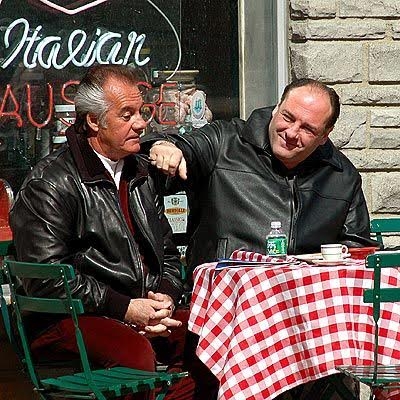
During a recent bout of viral pneumonia, I spent three days sitting in my lounger, sick, but not so sick I couldn't watch, again, and appreciate ALL of the episodes from seasons 1,2,3, and 6 of the Sopranos....about 60 hours.
It's arguably the best television series of the past 20 years... ugly, bloody, violent, sexual but also chocked full of tales and lessons about the meaning of family, of true friendship, of accepting defeat and celebrating victory. The production values and writing are unsurpassed (sorry, The Wire lovers).
So if you get sick, and still have the stomach for it, pick up the Sopranos at Family Video.
Be forewarned: Three days is an eternity at The Badda Bing Club.
16:21 Permalink | Comments (0) | Email this
December 31, 2010
"Oh Cisco!" Oh, Pancho!"
The Cisco Kid is in Battle Creek, Michigan USA. Nearly 60 years after his TV debut in the early 1950s.
I watch him some evenings. Just as I did as a nine year old.
Like The Lone Ranger, Cisco Kid always captures the bad guys and whows the ladies.
Unlike the Masked Man, who today seems a bit stuffy and even condescending, Cisco Kid still has a sense of humor, natural acting ability, and a good time with his sidekick, Pancho.

Viewers can count on a joke, and the famous “Oh, Cisco!", "Oh, Pancho!” at the close of each episode.
In real life, Duncan Renaldo was evidently as nice a guy as the one he played on our tv sets, according to Internet and print articles about his life.
He also had a secret – one that would get him in hot water, even today.
Renaldo was an illegal immigrant from Spain.
Born in 1904, he never knew his parents. He came to the U.S. in the 1920s, working on a Brazilian coal ship.
He overstayed his 90-day visa, and was arrested in the 1930s and threatened with deportation.
U.S. President Franklin D. Roosevelt eventually granted him a pardon.
In 1928 Renaldo started making films for MGM. His career soon dimmed when he became the 'Cisco Kid' in a 1945 film series that eventually wound up on television.
Along side Pancho (Leo Carrillo), the Cisco Kid won the day -- usually without drawing his pistol.
According to accounts, The Cisco Kid was wildly popular in his day -- among children and adult viewers.
The television series ended in the mid-1950s. (By that time, Renaldo was 51 and Carillo approaching 80 years of age.)
Historical photographs available on the Internet recall famous visits to county fairs and company-sponsored picnics by Renaldo in the early 60s. That was how he made his living after the movie and tv lights went out.
With grace and good fun, Renaldo posed with local groups who remembered and loved his style and his smile.
Duncan Renaldo died in 1980 of lung cancer.
We could use a few more Cisco Kids.
"Adios, Amigo!"
"See you soon!"
"Ha!"
07:55 Permalink | Trackbacks (0) | Email this | Tags: writers who write
December 26, 2010
Curtain -- or Booty -- Call ?
*Sarah had energy, style, intellect, beauty and assertiveness.
So I asked her out on a date. We were adults; middle age. Liberal, well read professionals.
We went to a movie the first night.
And then on the second date, I had tickets for a Michigan State University home football game.
In retrospect, I should have known something when she used the men’s ‘john’ at half-time because the lady’s line was ‘too long.’
She bantered with the University boys in the line, and ignored the 'Woo Ha. Woo Ha," compliments that came her way...sauntering past the line of male back sides, smiles and urinals to the stalls.
Driving home from East Lansing, she invited me over the following weekend “for a casual, home cooked meal.”
So I arrived the appointed hour, with a nice bottle of California Sauvignon.
And rang her door bell.
Sarah opened the door, wearing a skirt and a kitchen apron.
And nothing else. From the waist up.
She smiled and welcomed me. We went up the stairs to her lovely apartment as if there was nothing unusual or needed to be explained, commented on.
I sat in the living room, reading the paper; occasionally glancing toward the kitchen where she mixed salad and removed cheese casserole from the oven.
She warmed the dinner plates. Impressive. How many people in places like Battle Creek, Saginaw or Grand Rapids heat their dinner plates?
We sat across from each other, in candlelight, with soft classical music playing from nearby speakers, toasted the night, and enjoyed the meal.
Talked politics. Favorite books. Job stuff.
And I thought, 'As odd as all this is, if she's not going to say anything, I'm not either."
We laughed knowingly over the fruit with rum sauce dessert, as if there was a third person at the table who didn't know our secret code or hand shake.
Around 9 p.m., it was somehow clear the evening was nighe over.
Sarah walked me slowly, casually to the front door.
Trying to delay things a bit, I bantered: "Do I get a rain check?"
She laughed, applying a chaste cheek kiss, "We'll see. This is just opening night."
Some time later, by delightful accident, I learned the first evening and Sarah’s ensemble had little to do with romance or sex.
She'd recently had breast implants.
And this was opening night. Like a Broadway Show.
Guess if I looked that good, I'd want the right people to see The First Act.
All I could think about that evening was a Curtain --or perhaps Booty -- Call.
----
*name and minor details changed to protect privacy.
05:08 Permalink | Comments (3) | Trackbacks (0) | Email this
December 23, 2010
30 Minutes With Gerry
I've been on a tear the last week or so, reading stories about the Pacific island campaigns (Tarawa, Guadacanal, etc) of WWII.
Most of us know that George Bush The First was a Navy pilot. Many fewer, perhaps, that Gerald Ford served quietly, with distinction, during some of the worst fighting in the Pacific.
![]()
But Gerald Ford, from his University of Michigan football days, to his U.S. Presidency, was never one to blow his own horn.
I hadn’t lived in Grand Rapids, Michigan long before I met former U.S. President Gerald Ford for the first, and last, time.
An afternoon meeting concluded in my office, and one of the participants mentioned he was going down to “visit with Gerry” at the Ford Presidential Museum. And he asked if I wanted to come along.
So we walked down Pearl Street, across the Grand River bridge to the Museum.
Inside, I noticed several men with the telltale lapel pins and ear plugs associated with the Secret Service.
But we were rather casually ushered into President Ford’s office at the Museum.
He got up and greeted us – particularly my colleague, who was an old friend.
And the three of us sat chatting about University of Michigan football, Bill Clinton’s reelection prospects, and local politics for about 30 minutes.
I was surprised at how ‘easy’ the conversation was; and that Ford seemed in no hurry to end the chat. There was no glancing at his watch; no shifting of his eyes in anticipation of the next meeting on his schedule.
Walking back across the Grand River bridge, my colleague told several endearing stories from his friend “Gerry” Ford’s some 25 years representing Grand Rapids and Michigan’s 5th Congressional District.
I was thinking about the President Gerald Ford who helped bring a close to Watergate, the Vietnam War, and dealt with Soviet expansionism and domestic inflation in the mid-1970s.
“He's a very common man,” my associate commented to me about Ford.
And much more, I thought to myself.
07:15 Permalink | Comments (0) | Email this
December 21, 2010
"Ma'm, that's mighty fine peach cobbler."
A friend was an iterant preacher and member of a musical quartet in the '50s, that made a meager living traveling the upper Midwest, performing at tent revivals and small town churches.
The quartet relied on generosity of the church faithful, including food and bed most nights.
When lucky,th
ey'd share a local farm family’s dinner table and fare.
The musical group's lifestye was one part religious fervor and one part snake oil salesmenship.
All that singing, traveling and living together bred more than a bit of familiarity. “Many an evening, we’d end up kicking each other under the dinner table,” my minister friend recalled.
One quartet member had his own Harold-Hill like sales pitch at the dinner table.
“That's mighty fine asparagus!,” he’d say, complimenting the household missus, while brushing off gravy stains and bread crumbs from his shirt front.
“Oh, you think so?” missus would say, acting surprised by the compliment. “Well, how about you havin’ a second helpin of that asparagus, then!”
After dinner coffee and dessert served.
Before table could be cleared of dishes, the siren song repeated.
“Oh, yes. Ma'm, that's mighty fine peach cobbler. Mighty fine peach cobbler.”
“Don't say, you tell me?” missus would respond, proud as a 4-H blue ribbon winner at the County Fair.
“I got a nice second piece for you rite here.”
08:40 Permalink | Comments (1) | Trackbacks (0) | Email this
December 20, 2010
Learning From Our Failures
Learning From Our Failures At This Christmas Time
As bad as things seem, for so many in America, at this Christmas, times WILL get better. They almost always do, if we take one day at a time, and keep moving forward in life.
All the whining about the U.S. being in "death throes," mirroring the decline and fall of the Roman Empire, leaves me nothing but bored and depressed.
Who needs it? And, I don't believe it for a minute.
Wasn't it just a few years back when we were ready to throw General Motors and Ford Motors into the trash heap of history?
Today? I'll take a new Ford, for quality and technology, over a Toyota, any day.
There's a grand tradition in this country of getting up off our ass*s, cynching up our pants, going back to work, and surprising people with our resilency, and our come-from-behind attitude.
We just like to bit*ch about things.
-
Orville Wright got kicked out of grade school.
-
Henry Ford went bankrupt four times.
-
The copy machine was rejected 10 years before the Xerox machine was finally introduced.
-
The fax machine failed when invented in the 1840s.
-
The Apple Newton PDA tanked when introduced; but many of its components are included in the tremendously successful I-Pad.
-
President Harry Truman had a lower popularity rating that Barack Obama – the joke of the day was: “To Err is Truman.” Yet Truman went on to deal with the Korean War, the birth of the nation of Israel, created the Department of Defense – and is today considered one of our top 5 or so U.S presidents.
Merry Christmas. Wanna join me in making it a good year?
06:40 Permalink | Comments (3) | Trackbacks (0) | Email this | Tags: enter keywords
December 17, 2010
The Art of Listening
On Listening
Humorist and author David Sedaris, in his latest book, says he finds most short story topics in his own life.
“No one could be as bad, as crazy as I’ve been,” he told THE STRAND on BBC World Service Radio early this morning.
Sedaris continued: “I wrote a short story about my Mom dying 17 years ago. Then I wrote another one. And then I wrote another one. I realized I was writing too many stories about my mom dying. My readers were probably getting bored listening.”
Truth is, our family life and our friends form the core of our experiences.
David Sedaris
Many of my own blogs, short stories and newspaper columns over the past three decades are based on people, places and personal experiences.
And some of those are as indelible today as death and dying.
For example, I loved my red-headed little Irish Mom telling, and retelling, the story of her delivering early morning papers, as an 8-year old, on the neighborhood streets of hometown Atchison, Kansas in the early 1920s.
“Want some ice tea? Come on, Jimmy. Let’s go out on the porch.” I knew she wanted to spend some time, at age 82, talking about her childhood.
She would usually begin: “I still know the names of every family on my paper route. The Kaybricks lived at 11 Parallel…the ….” And she was off to the races -- through a list of 24 or so names and addresses, door by door, usually throwing in a bit of family dirt.
My Mom was a GOOGLE MAP before Google Maps.
And she enjoyed the telling. It was therapy. A way to stay connected. To talk. To care. To bond.
Whether your Mom, or a friend, real listening, too, is an art and part, of loving or caring for someone. And it’s not always easy. Other priorities, distractions try to crowd in the mind and the day. (Photo: Jim with his Mom, Mary McNamara Richmond, shortly before her death in 2003.)
I listen to those I love and care about. Even when they repeat themselves. And, almost without exception, my real friends and loved ones have the capacity to listen when I need an ear, a smile, a word of encouragement.
There are many people with no capacity to listen. They only know how to talk.
How boring that must be.
08:03 Permalink | Comments (3) | Email this
December 14, 2010
Bus Stop Blues
Downtown Bus Stop Blues
She sat huddled, alone, in a corner of the clear plastic, doorless hut, a sharp , bitter wind blowing under the cigarette butt, trash hewn benches, chilling the feet of those waiting for the public buses.
The young woman wore dark glasses, dressed in a bulky brown jacket, winter scarf, sock cap pulled down below her ears to eye level. She appeared withdrawn, tiny, confused ... afraid.
Her grimy, off-white tennis shoes and thin, summer weight, brown cotton pants dripped melting snow when she moved. Wet stains crept up her pant legs to the knees.
One hand and arm clung tightly to a small bag, stuffed with a blanket.
The bag suddenly moved on its own, and she quickly adjusted the blanket, and slid to the end of the bench, avoiding two old men who’d joined us.
“You OK?” I asked.
She sensed the object of my concern, gently pulling back the blanket from top of the bag.
Out popped the homely, bugged-eyed head of a small pug dog.
“You know my cat died this morning. My dog is sick, too. I’m taking him to the vet in Athens,” she said. “PLEASE don’t tell the bus driver,” she implored.
"Athens?” I replied. “That’s 12 miles beyond Beckley and the end of your bus route. How’re you getting there?”
“I’m gonna walk. My vet is cheap. I don’t mind,” she said, removing dark glasses for the first time, tears welling-up above rose-hued winter cheeks.
The men watched, listened.
One laughed, commenting to his pal. “Nothing special. I used to walk to the Marshall jail.”
He took a swig from the sack, passing it to his friend.
Buses arrived, and we fled to our own, and our own lives.
I wondered later if the girl and her dog made it to Athens.
In the winter air and wet clothes.
And what I might have, but did not, do for her.
19:10 Permalink | Comments (0) | Email this | Tags: enter keywords
December 13, 2010
Even Shoplifters Have Tough Times
Shoplifters Can't Wait For Santa
The three young girls had stuffed the stolen blouses, slacks, caps and other items down their pants – right on the sales floor of the large, suburban, retail store, and then casually headed for the door.
They didn’t get far.
My friend, a long time “loss prevention” specialist for this and other retailers, was waiting for them at the door.
Nah, these kids weren’t shook being confronted by an adult for stealing.
They denied it. Sauntering across the parking lot.
“I chased them. They weren’t going to get away. And I called the cops,” my friend said.
The cops caught the kids.
Many retail stores make more than half their profits at Xmas time. They also suffer huge losses from theft by employees and shoplifters. My friend-the-loss-prevention-specialist said her store loses up to $200,000 from theft.
Stealing isn't just for the poor folk. As we know from national stories about the rich and famous pinching penny items in Hollywood boutiques.
“I’ve see it all. And I’ve seen them all,” she observed. She’s pinched the powerful and the prideful – the retired chair of a regional government, sons of a police chief, a downtown Pooh-Bah with plenty of cash in his pocket.
Two cop cars were parked next to the store. The three girls sat in the back seat of one.
“Don’t be quick to be critical of those girls,” my friend said. “A lot of these kids are from homes where there’s drugs, domestic violence. And where there’s no money at Christmas time....or anytime, when they need clothes. For some, this (stealing) is the only way they can get a new outfit or a pair of shoes.”
So much for stereotyped stealing.
Ask Winona Ryder.
06:50 Permalink | Comments (0) | Trackbacks (0) | Email this
December 08, 2010
Peeing In The Orange Juice Glass
A friend dropped by my place the other night...and wanted to share a short story manuscript he had just completed. I felt complimented that he would ask, and said: "OK, I'll try not to pee in the orange juice glass."
Most of us have a family member, colleague or friend who ALWAYS has to have the credit and the last word.
On the work site, we learn to give the boss credit for successes and to assume blame for failures. And to let the boss take ownership for the best ideas. (They usually do, anyway!)
Graphic artists intentionally make minor design mistakes or omissions so a client will catch them and feel an important partner in the creative process.
I worked as a journalist and writer for years – and then in management – and tried to stay mindful of how good copy, a good idea, a good project or a good employee -- can be spoiled by Alpha dog behavior of an enthusiastic supervisor.
For example: writers of all sort are a rather bilious lot, "full of envy, fear and self loathing" -- and notoriously negative about ANY blue edit marks, commonly referred to as "tweaks, " by a book or copy editor.
The old story goes like this:
'A writer is left on a deserted island with his editor.
The writer is starving.
All that is left is a glass of orange juice.
Days pass.
The writer is near death.
He is about to drink the juice when the editor grabs the glass from his hand and pees into it.
The writer looks at him, stunned.
"There," the editor says, handing back the glass, "It just needed a little tweaking."
I’m not sure how all this hangs together.
Maybe, simply that there's a difference between tweaking and peeing in the glass -- in most of our relationships; whether on the job, with the wife, teenage daughter/son, or friend.
And sometimes the best advice is no advice. And no tweaking.
Or, maybe I just need a good copy editor for this blogsite.
06:15 Permalink | Comments (0) | Email this
December 03, 2010
Gay Fatigue
Gay Fatigue
I was kinda relieved this past week, to see the "Don't Ask. Don't Tell." nonsense about gays serving in the U.S. military going away.
I don’t know about you, but I was starting to get a case of gay fatigue. What with U.S. soldiers dying in Iraq and Afghanistan, the unemployment rate in double digits, and the North Koreans on LSD, I figured we got a few other things to be concerned about.
But then I served on a U.S. aircraft carrier off Vietnam for three years in the late '60s, and never got so much as a wink, to say nothing of being propositioned in the head or the shower.
Our big worry wasn't gays, but all the lunkheads who sniffed glue out of 10-gallon cans and then tried to install Sidewinders or 500-pounders under the wings of an F-4 Phantom.
In 1982, only 32 percent of Americans were willing to accept people who were gay and openly practiced a gay lifestyle – today that number is closer to 60 percent.
Even through the ‘50s, if you were gay or bi-, and came out, goodbye to lots of careers, especially those in the movies or politics.
Today, Randolph Scott could take off his spurs and chaps. And Cary Grant his tux and top hat, and few of us would give a damn that they weren’t saints.
For that matter, I’ve always chose to remember Cary with another saint, Eva Marie, in North by Northwest.
06:06 Permalink | Comments (1) | Email this
December 02, 2010
Doing Well In America
Travel and foreign living experiences can be a reminder of how soft we have it in America -- even when the U.S. unemployment rate is in the double digits, and when one of our biggest concerns is if Congress is going to give us more unemployment benefits.
Fact is: We're fortunate to have been born and raised in this country.
All of us.
Relatively speaking.
During a visit to rural Ghana in West Africa a few years back, a new acquaintance commented to me: "We watch American soaps on our village TV. My son said: 'Mommy, mommy. I want to live in America. Even the poor people are fat in America!!'"
Living in Florida not long ago, my new landlords invited me to dinner, along with another friend who speaks fluent Spanish.
Landlords are Cubans. Mid 30s. Have been in the US for only four years.
The husband is this burly guy who looks more like a sumo wrestler from Japan.
The wife is attractive, with personal balance along with an obvious, strong love of her husband. (And much deserved pride in her home cooking.)
We sit outside in the night heat. Lots of laughter. Mostly in Spanish among the three others.
I watch their lips, trying to capture words, from my high school Spanish class, like lightening bugs.
We eat homemade tacos thick as Bibles; stuffed with fresh corn, meat, green peppers, lettuce, onions and sauce. Followed by thimble cups of thick, black coffee or Pepsi and a homemade Cuban custard.
The husband works as a welder each day.
During dinner, he rubs his arms to relieve large burns, presumably from a welding torch.
He can speak little English. His wife more. And their 8-yo daughter both, but has no Spanish accent.
Daughter is bored by the growups’ conversation and wanders back and forth from the patio to a small tv in the kitchen, where lipsticked, prepubescent girls sing in English while stage dancing on Nickelodion.
“Oh, Jessica mocks my English all the time,” the landlady says, looking at her nearby daughter, but laughing.
Landlord goes to work from 2 p.m. to midnight most days. I hear his car pull back into the drive.
By 8 a.m., he’s out in front of the house fixing other people’s cars; to make a little more money for his family.
Or he’s on the roof, installing shingles, finishing the rehab on our house, which he is turning into a three-unit. He appears to do it all: car repair, plumbing, framing, roofing, electrical, welding.
My Spanish-speaking friend mentions she wants to have a new bathroom added to her own house. We talk about cost of materials. Landlord suggests he could do it ‘in his spare time.’
His wife is upset. She tells us she doesn’t have enough to keep her busy.
She is raising their daughter.
She is going to school every day, full time to become a beautician.
She notices I’ve just had a haircut and wants to start cutting mine.
She hears my friend talking about cleaning my apartment every two weeks for $20, and says she would like to do it herself.
“I need more to do,” she says. ‘Or life gets boring.”
They’ve brought many skill sets, and a great attitude to America.
In Cuba, it was about 'making do.'
In America, these people will do well.
Even in these hard times for many of us.
05:55 Permalink | Comments (0) | Trackbacks (0) | Email this | Tags: illegal immigrants, work ethic
November 24, 2010
Ten Things More Fun Than Watching DWTS Finale
Ten Things More Fun Than Watching The DWTS Finale
#10: wisdom teeth removed with pliers
#9: reading GWB's DECISION POINTS
#8: listening to Sonny and Cher sing "I got you babe"
#7: hearing your girlfriend say: "It's not you, it's me"
#6: meeting with the IRS Audit Agent
#5: finding out the Viagra no longer works
#4: finding out the Viagra works to well
#3: finishing lower than Sarah Palin on the GRE(xam)
#2: trying to fit into your '69 Navy bell bottoms
#1: Answering the phone, to hear her say: "Honey, I think there was a hole in the condom"
06:32 Permalink | Comments (0) | Email this
November 09, 2010
"I'll GET YOU, MY SWEETIE!"
"I'LL GET YOU, MY SWEETIE!"
I'm not surprised Margaret Hamilton also taught elementary school. She looked, acted, in OZ like many teachers I had in grade school during the early and mid-'50s -- with several very notable exceptions. (Not that I or my twin were exactly at the 'head of
the class'.)
Have you noticed some elementary school teachers treat adults like children?
A little condescending. A little prescriptive.
A little too much parsing of an adult topic into simple concepts and outcomes.
My best bud from the 80s, (I ran 8 miles at 5 a.m. with him for years) was married to such a teacher.
Every Friday night, she would carefully write out a long " Weekend Honey Do" list for him and post on the frig door. He had to get it done by Sunday evening. Period.
She withheld many things from him, if he was derelict in his duties.
One Sat. she woke to her own life lesson.
During the night, he'd left. Permanently.
Had wiped her "assignments" from the frig door.
Left her his own version of a Saturday "To Do" list.
There's more than one lesson in this true story.
08:37 Permalink | Comments (0) | Email this | Tags: enter keywords
November 01, 2010
Hey, Mr. Postman
Hey, Mr. Postman!
Yes, Virginia, honey.
We called it a “Mail Box.” There was one on every house, and then one, like in this picture, in almost every neighborhood.
Odd as it might seem today, people wrote down their thoughts on what we called “paper.” They used something called a “pen” or “pencil.”
Grandma or Grandpa would then put the “paper” with their written thoughts into a wrapper, called an “envelope.” And stick a little glued photo on the outside.
And put the envelope in the “Mail Box.”
A strange lady or a man would stop at the “Mail Box”, usually once a day, and remove all the “envelopes.” The lady or man were called “Postmen.”
The “Postmen” were a proud people.
They picked up and delivered the envelopes even when it rained, or snowed, or flooded.
They wore strange blue and grey tribal clothes.
The envelopes went by train, truck and airplane, to another person, in another neighborhood, city, state or even country, somewhere around the world.
It would take three days for this to happen. Occasionally a week or more. And, once in a while, the envelope got lost and never arrived at all.
Imagine that!
Then the world changed.
People started using what were called “computers” for sending “email,” and for “social networking” on things called “Facebook”, “MySpace” and “Tweeter.”
The Postmen disappeared.
Then paper. Then envelopes.
And, so too, all but a few of these now abandoned, relic “Mail Boxes,” scattered in obscure, hidden away places.
Silent symbols of a different time.
08:57 Permalink | Comments (0) | Email this
October 21, 2010
Reelect Jim Haadsma As Calhoun County Commissioner

Vote for Jim Haadsma
In politics, and especially at election time, talk is cheap. Promises are cheap.
I encourage you to vote for a straight shooter, a guy who’s gotten things done for all of us in Calhoun County the past two years:
Reelect Jim Haadsma as Calhoun County Commissioner.
For more information on Jim's outstanding record of service, please go to: www.JimHaadsma.com
11:05 Permalink | Comments (1) | Email this
August 30, 2010
'Kill Chicken , To Frighten Monkey'
Kill Chicken, To Frighten Monkey !
China has recently passed Japan as the second largest economy in the world. By 2030, China is expected to pass the United States. With more than 3,000 years of history and culture, the Chinese can be sophisticated, friendly and master tacticians. They can also be crude, cruel and ethnocentric. The following is my personal story -- from when I was living in China from 2000-2003. -- Jim Richmond
The Chinese love fish head soup. With the head left floating in the broth.
The cheeks of the fish head are considered the most delicate and desirable.
The guest of honor at the typical Chinese dinner is offered opportunity to eat the fish's cheeks.
Nibble. Nibble.
Which I did one evening .
Dinner with my Chinese wife and her family in Dalian, northern China, just across the Yalu River from N. Korea .
A typically crowded, noisy, smoky Chinese restaurant -- families having dinner, business/communist party officials soaking up free food and drink.
About 20 of our extended family members sit around a large dinner table.. rotating food platter in the middle -- stacked with perhaps 30 different food dishes.
01:50 Permalink | Comments (0) | Trackbacks (0) | Email this
August 23, 2010
"Mr. Mac"
“Mr. Mac”
By Jim Richmond
To some, he was known as “Teddy Mac,” to others, just “Teddy,” but at work, it was strictly “Mr. Mac.”
He was “Uncle Teddy,” (McNamara) to me.
The McNamara’s, a first and second generation Irish immigrant family, lived in the small, river bluff town of Atchison in northeast Kansas, moving there after a short, unhappy existence of digging and planting on the kin’s Begley family farm near Potter, Kansas.
Photo Caption: (left to right) Bobby, Jimmy, Teddy, Mary, Tommy and Johnny McNamara. Photo taken in Atchison, at their father’s Catholic funeral. About 1956.
Teddy was one of five brothers – Jimmy, Tommy, Bobby, Johnny – raised largely through teen years by their Irish widower of a father, Thomas
and small, red-headed sister Mary, who had to “step up” at age 13, when wife and mother, Anna Begley McNamara, died after a five-year-long TB wasting.
Anna died in the upstairs bedroom of their small house on Parallel Avenue, the same day that husband, Thomas, lost his job with the Atchison, Topeka and Santa Fe Railroad engine repair yard.
Shortly after her mother's death, little Mary broke both her arms. The doctor put her on the kitchen table in the McNamara house, tried to straighten and then set her arms. But they would remain crooked the rest of her life.
Mary dropped out of high school for awhile to manage household chores, do the laundry, housekeeping and cooking for her father and unruly band of brothers.
The McNamara brothers were Irish to the core -- lovers of life, family, Catholic faith, and “tip and taste of the brew.”
Mary said that -- except for soft hearted and especially considerate Tommy -- her brothers had a bit of the Irish devil in and about them. It was a challenge for the teenage girl to care for six men in the home.
Teddy McNamara was also loved by the young ladies in Atchison, Mary recalled, in a 1992 videotaped interview, when she was 77.
“Oh, Teddy also kept Pop on his toes, trying to keep track of him,” Mary said with a laugh.
One Sunday morning, Teddy told his dad he was off to attend Catholic Mass. Just an hour later, Pop McNamara ran into a neighbor while shopping in downtown Atchison.
“Good morning, Thomas,” the neighbor said. “Sure and enough, I just saw your Teddy watering the grass front of that tavern by the river.”
To keep up with the ladies, and in order to afford decent clothes in his poor Irish family, young Teddy Mac also changed jobs frequently and acquired a talent for selling almost anything, to anyone, Mary recalled.
He had a short-lived job selling bedroom furniture. Teddy was about to close a mattress sale with his own dad. “But he wanted Pop to pay full price and full commission,” Mary chuckled.
Later in life, Teddy became somewhat of a business legend in Kansas City for his detailed knowledge, skills and toughness in purchasing fresh vegetables and frozen food items that were then, in turn, sold to area restaurants, hospitals and retail outlets by Pisciotta’s Frozen Foods and Vegetables, an Italian family business.
While the Italians owned and ran the business, with a fleet of trucks and warehouses, everyone called Teddy McNamara, “Mr. Mac,” out of respect for his buying and selling talents and contributions to the business’s success.
He was Pisciotta’s purchasing manager, and knew good bananas from bad like no other, and how to turn around and sell a train load of frozen French fries, hardly before the train had arrived in the Kansas City station.
It was said that no one could barter or buy like “Mr. Mac.”
I was about 17 when he got me an after-school job at Pisciotta’s.
I’d ride the bus from De La Salle Academy to the business’s location near the farmers’ market, in the “river bottoms” north of downtown Kansas City.
For a couple dollars an hour, I’d sort blue copy invoices, help the office staff, and any small errand “Mr. Mac” or “W.E.” Pisciotta (the family scion and business’ CEO) might have for me.
I valued the job, and learned by watching Uncle Teddy and the Italians.
And while Uncle Teddy and I were Irish, the Pisciottas treated us – like most of their employees – more like members of their extended Italian family.
Several times, W.E. gave me cash advances so I could buy a new refrigerator, or other big ticket item, for my mom on her birthdays – deducting $15 from my weekly paycheck to pay him and Pisciotta’s back.
Well before my own teenage years, all but Tommy of the McNamara brothers had moved from Atchison to Kansas City or elsewhere. (Mary met and married Charles E. Richmond in Atchison, and the couple relocated to Kansas City, where they raised their family.)
On many Saturdays, Teddy, Johnny and Bobby would show up at our house, getting out of one car en masse for an unscheduled visit, with a six pack of beer and heads full of blarney.
More often than not, Teddy would also have a crate of free Pisciotta groceries and vegetables for my Mom.
Mom always had a place at our Kansas City home, table and in her heart for her brothers. And they, in turn, treated her with a quiet deference and solicitude that probably had something to do with the Atchison years and her help in raising them.
Living in Kansas City, Teddy and his nurse wife Delores raised three daughters, Gerri, Kathy and Jeannie.
The girls roughly paralleled the ages of me, my twin brother John and older sister, Martha. So we saw a lot of the Teddy McNamaras in Kansas City.
Gerri tells me she and her sisters thought we lived in “a mansion,” while I recall our place on Coleman Road as a nice, but modest three bedroom home.
Memories of youth are in the eye of the beholder, because, in turn, I remember Uncle Teddy, Aunt Delores and their girls always had lots and lots of food, and bottled soft drinks when we visited their home. (Bottled soft drinks were a rarity at our house, reserved for special occasions. Our three cousins seemed to have all they wanted, whenever they wanted it. Big time distinctions for kids in the early to mid 1950s!)
The McNamara brothers, and sister Mary, have long since died.
Starting with Tommy, in Atchison, in his early 40s of a heart attack and with a young family, and ending with Mary, at 88, in 2003, they dropped like the individual petals from a bright green shamrock.
After Teddy’s funeral, we followed the casket and the long line of cars from Church to the Catholic cemetery and then to the gravesite.
It was a cold, blustery day.
After the service, I turned with the crowd of mourners, heading back alone, I thought, to my car.
Next to me, walking slowly up the cemetery road was W. E. Pisciotta – still the “boss” but much older, Italian good looks misshapen by age and illness. He was breathing hard as we inched toward the cars together.
I felt honored for the moment with him, remembering from my youth his business skills, his family’s open heart to their employees, his personal generosity to me.
“Jimmy, your Uncle was somebody special,” W.E. said, simply.
We walked on silently in the chill, and parted.
W.E. was a man of few words, great presence. His six words that day imprinted on my mind, remaining for 40 years.
He, too, did not live much longer, after our cemetery road meander.
And while Uncle Teddy, “Mr. Mac,” his Irish brothers and my mom are gone, they have left, in their places, several blossoming generations of McNamaras, plus extended relatives with melting pot names like Borkowski, Richmond, Goble, Van Meter, Dunwiddie, Jertson and Meyer. And many carry on the Irish traditions a bit, remembering their own versions of stories about Atchison, and the McNamara’s brothers and sister who came before them.
Teddy -- “Mr. Mac” -- will always be a special uncle: An Irish Uncle with character, guts, humor, talent, and love of family.
He knew a lot about bananas and French fries.
He taught a lot more about selling, dealing with people of different backgrounds, races and cultures, and what it means to be a standup guy.
“Mr. Mac” left a legacy, and me with lots of great memories. 
Photo Caption: Teddy McNamara , with Grandson Jon VanMeter
07:31 Permalink | Comments (0) | Email this
August 06, 2010
Change on the Morbid Motor Mile
Change is good.
Change is unavoidable.
But, sometimes change can seem a bit strange.
Take the old Henkel Auto Showroom on “The Motor Mile” stretch of car dealerships along Dickman Road in Battle Creek.
Smack dab between and among Heritage Chevrolet, DeMaag Olds, Sunshine Toyota, Lakeview Ford dealership showrooms and sales lots is a new neighbor, new addition.
The old Henkel showroom and lot is being transformed into ‘Baxter Funeral and Cremation Services.’
There must be a Motor Mile synergy here. I just don’t see it.
Perhaps it’s the proximity in being able to get your oil changed and funeral planned while you wait.
Maybe it’s straightout marketing.
Baxter can put a nice display and range of caskets and urns in its own, new ‘showroom’ and on its lots:.
One casket could have a display sign: “GUARANTEED FOR 1,000 YEARS!”
“WILL GET YOU TO THOSE PEARLY GATES!”
“A GODLY SPECIAL!”
“NO INTEREST FOR 100 YEARS!”
“DEVIL OF A DEAL!”
And there could be a display of attractive urns suitable for cremation remains.
“ALL BILLY WILL EVER NEED!”
“$500 COVERS EVERYTHING! NO EMBALMING! NO EXPENSIVE BURIAL PLOT!
Or another:
“PERFECT FOR THAT SPOT ON YOUR MANTLE!”
Let’s wait and see if Baxter can get along with its neighbors, and the competition.
11:42 Permalink | Comments (0) | Email this
July 23, 2010
Replacing Your Divot
A friend is fond of saying ... you can tell a lot about a person by playing golf with them.
No need for lie detector test. Credit or loan worthiness check. Number of points on a driver’s license. Asking what people think in the community. Just watch what they do on the golf course.
I was reminded of this several weeks ago when I played in a charitable golf outing. Full field of more than 122-plus golfers, all with their clubs in their carts…two to a cart….two carts to each hole. Ready to roll promptly at 9 a.m.
Except one person in our foursome: A very “visible” business person who usually wears fancy suits, $50 ties, and acts like he knows everyone and has all the answers to community problems.
And -- although I barely knew him --I forked over his $45 tournament fee, just in case he showed up at the last moment.
Which he did right before the gun went off, and our two “shotgun” foursomes were sent to the 12th hole to start our round.
He showed up with his 5’8, 14 year old son.
“Oh, none of you mind if Eric (name changed) just rides along,” he says, as his son squeezes in as the third person in a golf cart made for two.
None of us said a word.
But it was obvious the kid had no business on the golf course, when there was a “full capacity” adult tournament underway. Without clubs.
“Hey,” I thought to myself, “if the kid wants to ride along. And it’s a bit crowded. No big deal.”
But, of course, it was and is if you’re a golfer; if you believe in basic golf etiquette, and what it teaches about life, about respecting others, being considerate, taking your turn on the tee according to who won the last hole, not driving the cart close to the greens, etc.
Unless you don’t care what people think.
And this self described civic and business leader evidently didn’t care. And he probably knew better. He had nice clubs. Hit the ball a long way. Obviously played a lot of golf.
Worse: The kid started playing out of his dad’s bag, once we were out of sight of the course marshall and the club house.
Sometimes, there would be 8 players stacked up behind us on the fairway. Sometimes “dad “ let his son hit two balls.
Sometimes, dad would yell and criticize his kid:
“WHAT ARE YOU DOING!!!!!?”
“Get over here!!!!”
“Pick up that club!”
As we approached the 9th green, in site of the clubhouse, the adults got out of our carts with putters. And dad had the kid drive the cart rest of the way to the green.
Getting ready to putt, I turned and the kid had run the cart into a nearby tree, and was vainly trying to extricate himself from the overhanging branches.
I kept wondering why everyone in the tournament, in our two foursomes, let this guy (“dad”) slide in his example of terrible golf ethics.
I think I know why. But that’s another blog.
It took two weeks to get my $45 tournament fee back from the guy.
I’d pretty much decided the money wasn’t important. That none of it mattered to me, or in the great scheme of things.
But then I recalled this guy had run for public office last fall, and almost won.
And I’d almost voted for him.
You can learn a lot about someone on a golf course.
08:12 Permalink | Comments (0) | Email this
June 10, 2010
Rubbernecking and The Art of the 'Second Ask'
Rubbernecking and The Art of the ‘Second Ask’
I was fortunate to recently “chauffeur” a nationally recognized physician, educator and retired charitable foundation CEO around town.
We spent a lot of time in my old car; had many good discussions; and, caught up on when the two of us worked together 28 years ago.
I also learned much about the man; much I’d never known; or fully appreciated.
Of course, that’s the case with many of our relationships – is it not? Family, close friends, acquaintances -- almost everyone I’ve met over the past 65 years – and then taken time to listen to – has proven more interesting, layered, than I'd have imagined.
In the car, we got into a discussion about the “Differential Diagnosis” approach to disease identification, which students are taught in medical school. (http://en.wiktionary.org/wiki/differential_diagnosis). It is a step-by-step protocol for interviewing patients; finding out more about their lives, their concerns, their health.
I’m all for ‘differential diagnosis’ and wish we’d apply it more to our personal relationships and conversations.
How many people do you know who have only one question in them?
Example:
Bill: “Hey, did you get that car fixed, Tom?”
Tom: “Well, you know I took it in yesterday and…… (He is interrupted by Bill)”
Bill: “I had a 57 Chevy Bel Air coupe, white on pink, and let me tell you about the time that darn car broke down, too.”
A lot of people move on to their own personal experiences, to the “me” part of any conversation, before opening words are out of your mouth.
Either that, or they rubberneck to see who else they might talk to in the room.
So, I’m a supporter of the “differential diagnosis” approach to conversations. Listening to someone’s FULL response after you ask them a question; listening well enough to ask a second, amplifying question. That restates and focuses on what they have told you. Not on your own life experiences.
It’s a great way to really know people. To show interest and respect. And to separate yourself from rubberneckers in the room.
11:45 Permalink | Comments (0) | Email this
April 03, 2010
Death Bed Visions
Death Bed Visions
About 25 percent of people on their death beds describe having visions, where they are visited by long deceased family members – usually their mother or father. These “visits” are different from “near death” experiences.
Those on their death bed see and talk with the parent and, usually, report that the parent tells them: “I will be back to get you.”
After such a visit, hospice workers report that the person dying becomes peaceful. For more on this, scroll down to “Chapter 4” on this website: http://www.bbc.co.uk/programmes/p006pp68#p006zcrz
07:19 Permalink | Comments (0) | Email this
March 31, 2010
One Toke Over The Line?
One Toke Over The Line ?
There are two strange, new storefronts round the corner from where I work on Territorial Road near 20th street in Battle Creek, Mi., USA.
One is a makeshift, fertilizer and sun lamp filled “BC HYDRO” indoor plant -growing store. CALL 96-GROW.
The other has a sign in front: “Cereal City Compassion Club” with a marijuana plant for a logo.
Cars crowd the front and side lots during daylight hours. People enter and leave thru rear doors.
A blue and white, tied-dyed blanket hangs from the Cereal City Compassion Club window, blocking out curious eyes. “PRIVATE. Please enter in rear of Bldg.”
Medical marijuana relief, or pot- shops for Ann Arborites and aging hippies?
Could the new ‘business’ be part of an Economic Development Plan by our City Fathers?
Civic improvement at its creative, cutting-edge best?
After all, these roach-and-stem-loving folks replace the blind pig and after-hours gambling den that occupied the same storefront spaces until recently.
We got the number for 96-GROW.
Anyone know the one for Silent Observer?
Verdict In On Early Screening for Breast Cancer
A new study puts to rest the debate over the efficacy of early screening for breast cancer: benefits outweigh risks. For every 1 woman who is subjected to unnecessary surgery or other treatment, 2 women are saved as a result of early screening.
Amidst the study’s details, a rather remarkable comment by one of the study’s physician/researchers: “If only we could understand why and how some women’s bodies destroy the cancer without treatment. If we knew (the answer,) we could ‘cure’ breast cancer.”
For study details, go to: http://news.bbc.co.uk/2/hi/health/8594940.stm
‘Happiness’ Is Found in Our Relationships; Not Our Bank Account
That Porsche in the driveway might be kick-ass fun on the road and a real rubber-necker with the girls, but it won’t make you happy.
Worldwide comparisons of relative “happiness” reveal that net income, and salary raises, don’t mean much after you reach an annual income of about $60,000.
What makes people happy and content are their relationships, and when they reach out, and give back, to other people and their communities.
Read all about it, in this brief essay. Then: be happy. http://www.movementforhappiness.org/movement-manifesto
07:47 Permalink | Comments (0) | Email this
March 28, 2010
Getting Revenge
Getting Revenge
Revenge or forgiveness? Why do we not seek revenge against our genetic relatives? What are the key factors that make us willing, or unwilling, to forgive someone?
This is a wonderful NPR program ..... anxious to read his book. Enjoy. Go to: http://speakingoffaith.publicradio.org/programs/2008/reve...
08:23 Permalink | Comments (0) | Email this