Ok

By continuing your visit to this site, you accept the use of cookies. These ensure the smooth running of our services. Learn more.

  • Son Finds Hope After Jim Hazel's Death


    Hazels.father.son.jpg

    “I want to bring the (Service) Station back to its former glory:


    Son Applies Lessons, Finds New Hope After

    Iconic Father and Civic Leader Jim Hazel’s Death


    photos and story by jim richmond


    Next week will mark the first anniversary of Jim Hazel, Jr’s death, who was a Battle Creek civic leader and booster without peer for decades.

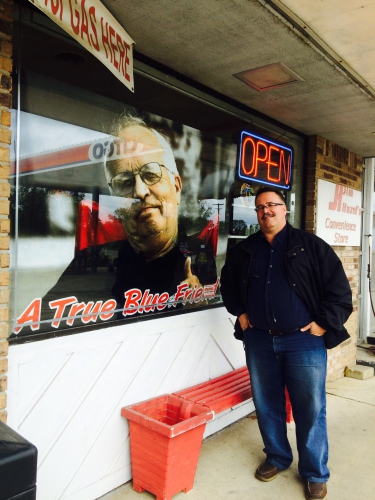
    Today, his son Jim Hazel III still runs the Citgo Service Station on Beadle Lake Road that has been in the family for three generations, and which has gone through good times and – more recently – tough financial times.Hazel Citigo.jpg

    But the sun is out and shining as far as Jim Hazel III is concerned.

    After straightening out complicated and inaccurate sales taxes debts on the station totaling $100,000 from the past 15 years, Jim is ready to focus on renovating the station to its “full service” status, with its historical emphasis on local, quality auto repair.

    Meanwhile Hazel, at age 50, is studying full-time at Western Michigan University, finishing a degree in telecommunications information management, after already earning an associate degree in law, and a master mechanic’s certification. While running the station full-time.JimHazelIIIcloseup.jpg

    “I was a late starter,” he said, laughing, during a recent interview.  “My Dad started working in the Station when he was 11 (years old).  I was 13.”

    His father took care of the business side, but his son learned more than how to pump gas and fix flat tires.

    “My dad was like the energizer bunny. He worked constantly.  And he was a ‘connector’ in the community.  He connected people together to get problems and projects solved in Battle Creek. He also taught me to keep going forward.  That you only have so much time in life.”

    The night before this interview, Jim said he sat in the Harper Creek High School football stadium, near a special area dedicated to and where his father always sat for games. 

    “It’s been a year.  But I sat there and teared up over Dad being gone,” his son said.

    But Jim is moving forward. 

    And he has high hopes and big plans:

    • To bring the station back to its glory days.
    • To give back to the community as a volunteer, as his father did. 
    • And with wife Nancy, to raise their daughter Alyssia, 14, and a Harper Creek High School freshman, in the Hazel family tradition of hard work and putting community before self.

    A year has passed. 

    But, son Jim still has a huge blowup photo of his Dad in the service station’s front window, as a tribute and a reminder.

    Photo or no photo.

    Many in Battle Creek will never forget Jim Hazel.

  • Hospital Confusion Over Ebola All Too Common


    Hospital Confusion Over Ebola Victim All Too Common

    Jim Richmond's Note:  The Texas hospital screw up in communication between nurses and physicians over background of the Ebola infected walk-in patient is all too common an experience for most of us.

    My cousin, a phd educated nurse practitioner and university faculty member, has often cautioned me, and others, “You, a family member or a friend have to be your own patient advocate in the hospital.”

    In Texas, TV network news are reporting this morning that the doctors and nurses had separate laptop patient information systems.   Systems that did not communicate with each other about the Ebola patient's travel history.

    So, take with a huge grain of salt, all the Interstate Highway advertising signs by megahospitals about how super efficient and effective they are….

    Truth is there are a lot of good, compassionate people working in hospitals. But they make mistakes, like the rest of us.  And  most big hospitals operate just like most other big businesses.

    And when you're a patient in one, you have to not only watch your back but cover your own ass. 

    Literally and figuratively.

    Here’s my own little, recent, true experience in back and ass covering at my “hometown” hospital.


    asscovering.jpg

    “STAT! STAT! Will The Hospitalist Please Call the Intensivist.”

    “STAT! STAT!  Will The Hospitalist Please Call the Intensivist.”

    By Jim Richmond

         I got wheeled onto a hospital elevator yesterday.  The elevator stopped and a middle aged man in a white coat and wearing the physician’s stethoscope around his neck, got on.

         Funny guy.  We bantered back and forth, as the elevator went up the floors.

         “A neurologist?” I asked the hospital attendant accompanying me, after the physician got off the elevator.

         “No. He’s an Intensivist,” the attendant replied.

         “Is that a new board certified medical specialty?” I pressed on. “What does he DO? Is he anything like being a Futurist?,” trying to joke a bit.

          “Intensivists are physicians who specialize in treating people in intensive care,” he said. “They work with the hospitalists.”

          “The hospitalists?” I asked.

          “Hospitalists are doctors who treat patients in a hospital.  They’re usually hospital employees.  We got lots of them,” the attendant said.

          “Oh.  What about the general practitioners and family docs?  The ones who saw you in their office, knew your medical history and problems, and visited you in the hospital.  They had something called ‘hospital privileges'; and made patient rounds in the mornings,” I said.

       My wheel chair attendant explained, “Hardly any family docs do hospital visits anymore.  It’s specialized now.”

          Yes, I thought.  2 ER doctors, 1 Physician’s Assistant, 1 Hospitalist, 1 Intensivist, 1 Charge Nurse, and 2 floor nurses, all asked me the same basic health background questions, while the majority of them also rather frantically typing my answers on their tiny laptops.

          “Aren’t all your laptops connected in one patient information system?  Do you have to ask  the same questions over and over again?,” I inquired, with a smile, of the CCU nurse.

          She seemed, only for a moment, a bit puzzled by my question. “Some hospital staff can only access part of the hospital

     records for a patient. You DO want your information to be accurate, don’t you?”

          “Certainly do,” I meekly replied, and a bit intimidated

    , checking to see the back of my hospital gown wasnt showing my cheeks.

          Lots of hands in the modern hospital pot these days. 

          Progress and technology move ever forward.

          I got excellent care at the hospital, by friendly, very professional people.

          But, I still miss Dr. Robert Oakes.  Our family physician (now retired), who birthed both our sons,  knew all about my bad knee, the kids’ childhood illnesses and allergies, and was always at the hospital too, when you needed him.

          Dr Oakes was my kind of intensivist. 

  • Bad Teeth: Can A Smile Be Your Umbrella

    Bad Teeth:

    Can A Smile Be Your Umbrella?

    Just let a smile be your umbrella,
    On a rainy, rainy day . . .
    And if your sweetie cries, just tell her,
    That a smile will always pay . . .

    Whenever skies are gray,
    Don’t you worry or fret,
    A smile will bring the sunshine,
    And you’ll never get wet!

    So, let a smile be your umbrella,
    On a rainy, rainy day
     . . .

    Many of us old-timers won’t soon forget Perry Como’s comfortable smile, singing this tune on his TV show during the late 1950s. Como and the song seemed to say optimism pays in life and that a smile can overcome much, including a rainy day.

    It’s still true today.
    badteeth.jpg

     Unfortunately up to 44 million Americans don’t dare smile because of the condition of their teeth, and don't have an umbrella for a rainy day, according to an article The New Yorker magazine.

    It reported on a  Harvard University study that  “bad teeth” is the No. 1 problem of Americans who can’t afford to go to a dentist.
     
    The Harvard researchers, for their book “Uninsured in America,” interviewed all kinds of people. The most common complaint was about teeth.
     
    There was Gina, a hairdresser in Idaho, whose husband worked at a chain store. Gina had “a peculiar mannerism of keeping her mouth closed even when speaking.”  Turned out she hadn’t been able to afford dental care for three years, and one of her front teeth was rotting.
     
    Daniel, a constructor worker, pulled out his bad teeth with pliers.
     
    Then, there was Loretta, who worked nights at a university research center in Mississippi, and was missing most of her teeth. “They’ll break off after a while, and then you grab a hold of them, and they work their way out,” she explained.
     
    Those Americans struggling to get ahead in the job market quickly find out that unsightliness of bad teeth is a major barrier. If your teeth are bad, you’re not going to get a job as a receptionist or a cashier.

    According to the study, bad teeth have come to be seen as a marker of “poor parenting, low educational achievement and slow or faulty intellectual development."


    I’d call it another “marker” of how we’ve become a society of have and have-nots.